

the power of protein: What it is & why it's important
You may have set yourself a goal for 2021 to build more muscle or to lose weight, so may have a program that revolves around resistance training. A supplementary protein product may be helpful if you’re unable to consume enough protein naturally through your diet. You may have scanned for products online only to be left feeling confused by the number of products out there.
But questions are now filling your brain and you need answers! Why is protein important? How does protein impact your ability to gain muscle? Does the type of protein affect this ability? And how much/when should you be consuming protein?

THE BASICS
Protein is a very important nutrient that is required for muscle growth and repair. Protein consists of small units, known as amino acids. When you consume foods containing protein, it is broken down into amino acids which then help to repair muscles that have been damaged from an exercise training session. In total, there are 22 amino acids, 9 of which are essential so need to be consumed through our diet as the body is unable to synthesise them. If a protein source is considered ‘complete’ it means it contains adequate amounts of the 9 essential amino acids, including foods such as meat, fish, whey, eggs, and some legumes. However, you may consume several foods together that don’t contain all 9 essential amino acids in order to create a complete protein.
Within amino acids are branch-chained amino acids (BCAAs). These are leucine, isoleucine, and valine. It’s been hypothesised that BCAAs can help repair muscle tissue after exercise-induced muscle damage and may reduce muscle soreness.

BCAAs: Leucine, Isoleucine & Valine
PROTEIN SYNTHESIS
Muscle protein synthesis (MPS) is also known as anabolism, the process of repair and growth of muscle mass that has been damaged in response to exercise, most commonly to resistance training. This primarily occurs during periods of rest and recovery. For muscle to grow, protein synthesis must exceed protein breakdown (MPB). MPB occurs following resistance exercise to help remodelling and adaptation of the muscle, but increases aren’t as great as MPS. If you’re getting enough protein through your diet, then you’ll have adequate amino acids to fuel the process and result in muscle growth.
When protein is consumed, amino acids are absorbed into the bloodstream and then delivered to the muscles damaged through exercise. Weight training and putting muscles under stress causes micro-tears in the muscle fibres which the body then repairs, causing the muscles to grow bigger and stronger than they previously were. So, even if you’re completing resistance exercise but not consuming enough protein, you may enter a negative protein balance whereby rates of MPB exceed rates of MPS, thus no muscle growth is seen.
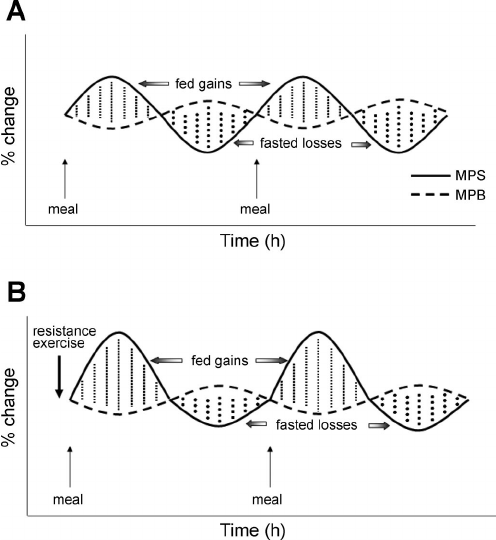
A: Changes in MPS & MPB in response to feeding. B: Changes in MPS & MPB in response to resistance exercise and feeding.
Graph taken from Burd et al. (2008) article 'Exercise training and protein metabolism: influences of contraction, protein intake, and sex-based differences'.
NUTRITION & MPS
Nutritional substances effect muscle protein metabolism and muscle growth. Increases in amino acid availability from protein consumed elevates MPS to result in a positive net protein balance (needed to build muscle). Following resistance training, MPB and MPS levels are elevated for more than 24 hours after, meaning protein consumed in this period may influence muscle protein metabolism.
Everybody requires an adequate amount of protein, recommended at ~1.5g - 2g/kg bodyweight to increase lean muscle mass and reduce body fat whilst maintaining muscle tissue. But protein isn’t only beneficial for weightlifters, they can also be a good recovery tool for endurance athletes or for those looking to lose weight.

TIMING OF INTAKE
There used to be this idea of the ‘anabolic window’, whereby protein needed to be ingested within the first 3 hours of recovery post-exercise. However, research has now shown there is enhanced sensitivity of MPS to protein ingestion following resistance exercise for at least 24 hours. In short, there’s no prime time to optimise MPS.
There has been seen to be a dose-response relationship in MPS to the intensity and volume of exercise as well as the protein consumed after exercise. MPS can be maximally stimulated by consuming 20g of high-quality protein. A study conducted by Areta et al. (2013) showed that rates of MPS remain elevated above rest throughout 12 hours of recovery following a single bout of resistance exercise (in healthy males with resistance training experience) then followed by partitioned consumption of 80g high-quality protein. This meant that daily rates of MPS were highest with a moderate protein intake of 20g whey protein every 3 hours following exercise. Furthermore, it was shown that phosphorylation of mTOR and p70 S6K (important cell signals for MPS) was also elevated in the 12 hours recovery, indicative of elevated levels of MPS.
This implies that spreading protein intake equally throughout the day rather than one large bolus intake following resistance exercise may be more beneficial when looking to increase muscle growth. This provides sufficient amino acids to be delivered to the muscles for repeated stimulation of MPS.

B: Myofibrillar FSR (rate at which a precursor compound is incorporated into a product per unit of product mass) throughout 1–12 h following a bout of leg extension resistance exercise and post-exercise BOLUS, INT or PULSE ingestion protocol during a 12 h recovery period.
Graph taken from Areta et al. (2013) article 'Timing and distribution of protein ingestion during prolonged recovery from resistance exercise alters myofibrillar protein synthesis'.
TYPES OF PROTEIN AVAILABLE
You may have searched through different websites for a protein shake blend and been bombarded with so many different types of protein. Protein powders come in several forms with the most popular being whey, soy and casein.
Whey is the most commonly used source of protein and the cheapest variety as it is a complete protein so contains all 9 essential amino acids-and is ‘fast acting’. Following resistance exercise and consumption of a whey-based protein, amino acid levels in the blood are seen to spike shortly after consumption. The protein can be absorbed into the bloodstream a lot quicker so increases the potential for MPS and a positive protein balance following exercise. But, you now have the added dilemma of whether to buy ‘hydrolysed’, ‘isolate’ and ‘concentrate’ varieties of whey.
Hydrolysed whey has been broken down from whole proteins into smaller groups of amino acids called peptides. This means that digestion speed is increased so it can quickly provide a supply of amino acids for faster absorption by the muscles. Whey isolate refers to the whey being in its purest form so contains the highest protein content, containing no/very little lactose, sugar, or fat, and so may be suitable for those who have a lactose intolerance. Put simply, whey isolate is a more refined form of protein powder with a higher protein percentage content.
If you are a vegetarian, you may choose to consume soy protein, a plant-based protein that still contains all the essential amino acids. Research has found soy protein performs comparably to whey in terms of stimulating muscle growth after resistance training, but it’s been shown that soy has added benefits of inhibiting negative effects of training on antioxidant status.

POWDER VS FOOD: WHICH IS BETTER?
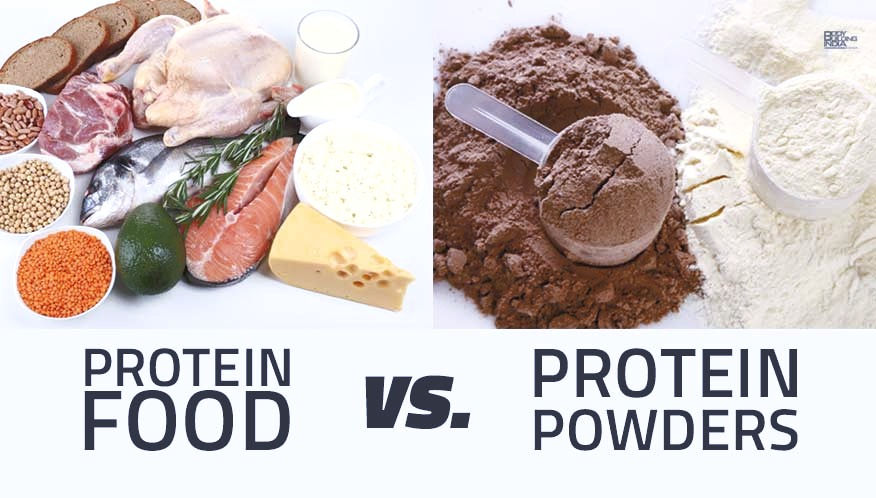
It is recommended by most nutritionist or dieticians that a ‘food first’ approach should be taken when discussing general nutrition. When discussing optimal protein intake, it must be considered that the protein needs to be a high-quality protein source consumed through either food or in the form of protein powder.
Consuming protein from whole foods means they also provide other vitamins and minerals and promotes digestive health and satiety; you feel fuller for longer. But if you struggle to hit the required levels of protein recommended for your body weight or goals, then shakes provide a convenient and quick way to increase protein intake alongside a balanced diet. But consider how active you are first and what workouts you’re completing first, for instance a highly active individual who completes a lot of resistance training will need more protein than a sedentary person.
Also, research has shown that a combination of resistance training and whey supplementation leads to increases in lean body mass. But as has been mentioned, protein isn’t only for those looking to build muscle. A review published by the American College of Nutrition in 2018 found overweight participants who supplemented their diet with whey protein lost more weight and fat mass over various trial periods of time than a control group who didn’t supplement their diets. This isn’t to say that consuming protein shakes is superior to food. As long as an adequate amount of high-quality protein is consumed for you as an individual based on the recommendations, it doesn’t matter if protein is consumed by food alone or is supplemented with protein shakes.
TAKEHOME
Whether you currently use protein shakes or not, and are trying to build muscle or lose weight, consuming both protein from whole foods and powders has benefits. Protein is KEY in being able to build muscle following resistance training. Aim to consume 1.5-2g of high-quality protein per kg bodyweight per day, and in equal amounts throughout the day. Plus it doesn’t need to be consumed immediately after resistance training!
Remember, aim to achieve adequate protein intake through a ‘food first’ approach, but if you’re unable to consume adequate amounts through food, then protein shakes are a quick and convenient supply of high-quality protein to build muscle. Don’t substitute meals or all of your protein intake for shakes, supplement your diet with them.

References
Areta, J.L., Burke, L.M., Ross, M.L., Camera, D.M., West, D.D.D., Broad, E.M., Jeacocke, N.A., Moore, D.R., Stellingwerff, T., Phillips, S.M., Hawley, J.A., and Coffet, V.G. (2013). Timing and distribution of protein ingestion during prolonged recovery from resistance exercise alters myofibrillar protein synthesis. The Journal of Physiology, 591.9, 2319–2331
Brown, E.C., DiSilvestro, R.A., Babaknia, A. and Devor, S.T. (2004) Soy versus whey protein bars: effects on exercise training impact on lean body mass and antioxidant status. Nutritional Journal 3, 22
Burd, N.A., Tang, J.E., Moore, D.R., and Phillips, S.M. (2008). Exercise training and protein metabolism: Influences of contraction, protein intake, and sex-based differences. Journal of Applied Physiology, 106(5), 1692-1701
Burd, N.A., West, D.W.D., Moore, D.R., Atherton, P.J., Staples, A.W., Prior, T., Tang, J.E., Rennie, M.J., Baker, S.K. and Phillips, S.M. (2011). Enhanced amino acid sensitivity of myofibrillar protein synthesis persists for up to 24 h after resistance exercise in young men. Journal of Nutrition, 141, 568– 573
Devries, M. C., and Phillips, S. M. (2015). Supplemental protein in support of muscle mass and health: advantage whey. Journal of food science, 80(1), 8-15
Levenhagen, D.K., Carr, C., Carlson, M.G., Maron, D.J., Borel, M.J., and Flakoll, P.J. (2002). Postexercise protein intake enhances whole-body and leg protein accretion in humans. Medicine and Science in Sports and Exercise, 34(5), 828-837
Tipton, K.D., Elliott, T.A., Cree, M.G., Aarsland, A.A., Sanford, A.P., and Wolfe, R.R. (2007). Stimulation of net muscle protein synthesis by whey protein ingestion before and after exercise. American Journal of Physiology, 292(1), 71-76
Tipton, K.D., Hamilton, L., and Gallagher, I.J. (2018). Assessing the role of muscle protein breakdown in response to nutrition and exercise in humans. Sports Medicine, 48(1), 53-64
K. Wirunsawanya, S. Upala,V. Jaruvongvanich and A. Sanguankeo (2017). Whey Protein Supplementation Improves Body Composition and Cardiovascular Risk Factors in Overweight and Obese Patients: A Systematic Review and Meta-Analysis. Journal of the American College of Nutrition, 37(1), 60-70


Comments